VPM News Focal Point
Aging Well | May 04, 2023
Season 2 Episode 10 | 26m 46sVideo has Closed Captions
Long-term care facilities; art renewing a sense of purpose; An 82-year-old athlete
Growing old gracefully; The benefits and challenges of long-term care facilities; For some older people, art is the key to a renewed sense of vitality and purpose; An 82-year-old athlete proves you are never too old to compete.
Problems playing video? | Closed Captioning Feedback
Problems playing video? | Closed Captioning Feedback
VPM News Focal Point is a local public television program presented by VPM
VPM News Focal Point
Aging Well | May 04, 2023
Season 2 Episode 10 | 26m 46sVideo has Closed Captions
Growing old gracefully; The benefits and challenges of long-term care facilities; For some older people, art is the key to a renewed sense of vitality and purpose; An 82-year-old athlete proves you are never too old to compete.
Problems playing video? | Closed Captioning Feedback
How to Watch VPM News Focal Point
VPM News Focal Point is available to stream on pbs.org and the free PBS App, available on iPhone, Apple TV, Android TV, Android smartphones, Amazon Fire TV, Amazon Fire Tablet, Roku, Samsung Smart TV, and Vizio.
Providing Support for PBS.org
Learn Moreabout PBS online sponsorshipANGIE MILES: For as long as we live, we are aging.
How do we age well with the best health, the most happiness, the greatest sense of wellbeing?
We're about to examine those questions as we look at life for older Virginians.
We're going to talk about physical and mental decline but also thriving in later years.
We'll look at lessons of the pandemic in our nursing homes and breakthroughs happening for our seniors.
You're watching VPM News Focal Point.
Production funding for VPM News Focal Point is provided by The estate of Mrs. Ann Lee Saunders Brown.
And by... ♪ ♪ ANGIE MILES: Welcome to VPM News Focal Point.
I'm Angie Miles.
The number of older Americans in our country is growing faster than just about any other age group.
By 2040 a projected 80 million Americans will be older than 65.
We're going to take a look now at life for older people and what can make it better.
Baby boomers, those born between 1946 and '64 have broken the mold in many ways and continue to innovate as they face retirement.
News producer Adrienne McGibbon looks at how this generation is changing what it means to be retired and why that change may be necessary.
ADRIENNE MCGIBBON: Bonnie Bartley and Laura Davis are two of Virginia's baby boomers who have entered retirement.
BONNIE BARTLEY: I really wasn't ready to retire.
I just said, ‘You know, I love what I do, I want to keep doing it.
And fortunately for me, the people that I worked for was in agreement, so I worked until I was 76, and it was great.
ADRIENNE MCGIBBON: About 16% of Virginians have reached retirement age, but like Bonnie, not all of them are leaving the workforce at 65.
MATT THORNHILL: As they've gone through life, they've transformed kind of culture and life and society here in America.
At every stage of life they've done it.
And now they're at that retirement age and looking forward to the next 10, 20, 30 years, they're already transforming what it means to grow older in Virginia and across the country.
ADRIENNE MCGIBBON: Matt Thornhill, who wrote the “Boomer Consumer, ” says many people in this generation are living longer and that's causing a population shift.
MATT THORNHILL: Social scientists would talk about that as the population age pyramid.
You know, a triangle, with more on the bottom and less on the top.
Well, since about the 1960s, we've not been making enough young people, so to speak, and the thing has changed.
It's not a pyramid anymore.
We have actually turned into a pillar.
ADRIENNE MCGIBBON: By 2030, one-fifth of the population will be 65 or older.
Thornhill says Virginia should consider that an opportunity.
MATT THORNHILL: How do we tap into this army of older adults who are out there, again, with wisdom and experience and knowledge and maybe even money, to help nonprofits, to help communities, to help organizations, kind of make a difference in their community?
ANGIE MILES: Virginia is regularly ranked among the top states for retirees because of its relatively low taxes, access to cultural opportunities, and high quality healthcare.
ANGIE MILES: The fact that more older Americans are working longer is sometimes a matter of financial need, but it's sometimes by choice.
And in all cases, it can do a lot to help an individual stay physically and mentally fit and maintain connections with others.
We asked people of Virginia to share their thoughts on what it takes to age well.
LOLA BROOKS: Well, I can talk about myself.
I do yoga.
I walk every day and I eat healthy.
RICK HERRON: I'm 67 right now and I'm enjoying life.
Life is good for me.
I try to stay active.
I live at the lake.
I still try to water ski a couple times a year.
So yeah, life is good.
RICKIECE POULSON: I think to stay youthful, people still need to hold onto their youth, so I think they need to still remember what made them happy as a kid.
I think when we get old sometimes, we kind of, we think we need to be a certain way and we try to fit into the norms of society, but what made us happy is just running in the sand or picking up those blocks and just seeing what you can create.
GAIL WEATHERFORD: You have to be physically active, you also have to surround yourself by with friends and family for social support.
I mean, that's proven to be important in staying young and healthy and have interests and always learn and try to learn new things.
ANGIE MILES: A difficult lesson we've learned is that COVID-19 still poses significant dangers, especially for older adults.
At the height of the pandemic, the Virginia Department of Health reported that Virginia's long term care facilities were home to more than 50% of the state's reported Coronavirus outbreaks.
Other senior living facilities also struggled to contain the virus.
Multimedia journalist Keyris Manzanares brings us this story.
(playing piano) KEYRIS MANZANARES: Anne James, a piano teacher who lives in a Richmond retirement community, remembers the COVID-19 lockdown.
ANNE JAMES: We were advised to stay in our apartments as much as possible.
We had special times to pick up our mail so that there wasn't too much opportunity to see people.
KEYRIS MANZANARES: James says she felt safe because of strict COVID protocols in her community, but was concerned about the deaths at Canterbury Rehab and Healthcare Center.
ANNE JAMES: It was terrible that one of the nursing homes not far from here had many, many deaths.
JIM WRIGHT: We saw COVID appear in New York City, then Washington D.C., and we could see it move down I-95, Fredericksburg and then that first case in Richmond.
And we realized that A, it was infectious.
B, there was no cure.
KEYRIS MANZANARES: Dr. Jim Wright is the former medical director of Canterbury Rehab and Healthcare Center where he worked for 10 years.
JIM WRIGHT: We were thinking in our nursing home of about 140, 150 people, we would have somewhere around 25 cases.
And out of those 25 cases, we could expect somewhere around four to five deaths.
KEYRIS MANZANARES: But the center experienced one of the worst outbreaks of COVID-19 in the United States.
At the end of the first outbreak in May, 2020, Dr. Wright says 50 people had died.
JIM WRIGHT: At the beginning, you definitely had the sense that we were a little ignored slice of society that really didn't matter that much and resources were not going to be diverted into the nursing home.
KEYRIS MANZANARES: Canterbury staff feared they would get COVID, resulting in staffing shortages.
Dr. Wright says it was chaos.
JIM WRIGHT: You had to work like you were in a combat zone.
‘I have to get oxygen to this patient.
‘I have to get IV fluids to this patient.
‘I have to make sure they're hydrated, eating and drinking.
‘I have to change them.
‘I have to get them to an isolation room.
You just had to focus on each individual task.
You could not stop to think about the big picture 'cause it would crush you.
KEYRIS MANZANARES: Dr. Wright says the Virginia Department of Health responded by providing testing for the center.
Dr. Laurie Forlano, the Acting State Epidemiologist at VDH, says at the start of the pandemic the state lacked the tools to deal with the virus.
LAURIE FORLANO: We've learned a lot about the COVID-19 virus, how it's transmitted, how it presents itself in a person, and how it can spread and how we can, importantly, how we can control it.
KEYRIS MANZANARES: Now, the challenge is continuing to get shots into arms and making sure people's vaccines are up to date, especially for older Virginians.
LAURIE FORLANO: There's plenty of places still to get free COVID-19 vaccine and get those bivalent doses in for extra protection, particularly for people who are older or more immunocompromised.
ANNE JAMES: The vaccine was such a gift and it gave us back our ability to be in the community and out and about.
(playing piano) ANGIE MILES: Canterbury Rehab and Healthcare Center in Richmond declined to participate in our report.
Earlier this year, Governor Glenn Youngkin signed the state's first law requiring minimum staffing for nursing homes.
Advocacy organization AARP Virginia says the legislation is a start, but much more needs to be done to protect older people.
ANGIE MILES: VPM News Focal Point is interested in the points of view of Virginians.
To hear more from your Virginia neighbors, and to share your own thoughts and story ideas, find us online at vpm.org/focalpoint.
ANGIE MILES: Aging can sometimes mean losing independence as well as connection with others.
This can be especially true for those suffering with Alzheimer's or dementia.
But a breakthrough program delivered in senior living facilities is fostering new connections, enabling older individuals to express themselves and maybe uncover hidden talents through art.
A Virginia nonprofit called Art for the Journey is championing an evidence-based approach called Opening Minds Through Art, and together with Leading Age Virginia, they're utilizing more than a million dollars in grant funding to help expand this mind opening journey.
(indistinct chatter) SALLY GUNN: I mostly do art that is detailed.
Had there been more schools available at the time when I was coming through college, I would've liked to have gone to a school that does medical art.
I love detail.
ANGIE MILES: When they said to you, "Oh, this is going to be abstract art."
What was your response?
SALLY GUNN: ‘I can't do it.
(laughs) But it's funny.
You get this piece of paper in front of you and all of a sudden the blank paper becomes filled with color and a theme.
It just comes.
It's amazing.
So, doing this kind of art was a stretch for me and I've just kind of let everything loose and it feels good.
CINDY PAULLIN: Art for the Journey is a Richmond based nonprofit arts organization, and the mission is to transform lives through art and community.
And Opening Minds through Art or OMA is a program that is developed by a gerontologist in Ohio that we brought to Virginia and deliver to seniors around the region and beyond.
This program is personal to me.
I was my mother's caregiver.
I felt a sense of not being able to help her as she suffered a stroke and eventually Lewy body dementia.
I cared for her in our home and then I cared for her by visiting her in assisted living.
And every time I drove away from her, I cried because I couldn't find a way to save her from this fate.
So years back, in 2015, when I learned about this wonderful opportunity becoming certified in OMA was life-changing for me.
DIANNE SIMONS: OMA restores energy and love and passion and joy and connection.
And there are so many people in nursing homes who need people attention and they need to exercise their creativity, their minds, and their talents and their abilities.
We do something called Inspirations where the artist is shown a couple of examples of the project that's going to be done that day.
And they're intentionally very different; different colors, different designs.
They all end up unique.
But you ask them, ‘Which do you prefer?
So that's the question the volunteer asks, "Which one do you like better?"
And that involves increased brain activity to move because they have to look left, they have to look right.
And in that process, it requires their cognition and for them thinking.
But there's no right or wrong answer.
STEPHANIE SHANKS: The process of creating a piece of OMA art is structured so that you know what to do at each step of the way.
But choices are also built into the process.
So everybody both feels empowered by knowing that there's a next step that they're not going to have to take a risk that's too big for them but also that they can make a choice and feel really free to choose the blue and the green colors together or the pink and the yellow.
And they know that those will work well together.
So that's an empowering aspect of the failure-free design.
NAN PASCAL: I learned that amazing art can be created by people who have what they perceive as no artistic talent.
And when I invite a resident to participate in an OMA class the very first thing that they say to me is, "But I'm not an artist."
So now I say, 'Good, I'm glad you're not.
I think you're really going to like OMA.'
BARBARA THORNTON: So first I say, 'I can't draw or do nothing like that,' you know?
So, she said, “Just try it.
” And once I tried it, you know, I really liked it.
(laughs) I've been doing it ever since.
CINDY PAULLIN: Well, one of our wonderfully talented artists is Mrs. Thornton.
She discovered later in life that she is an artist.
And from what I understand, she never had practiced any kind of art until OMA.
So what's really special is for somebody in their later years maybe octogenarian has discovered that she or he is an artist and can be a professional artist!
BARBARA THORNTON: And we take our time and do it, then we ask, ‘Are we satisfied with it?
You know, and after we finish it and they show it around to everybody, everybody looks at everybody picture.
EMPLOYEE: This is by Ms. Thornton.
It's called “Picket Fence.
” (crowd applauds) BARBARA THORNTON: Most everybody clap, make you feel really good.
You know.
EMPLOYEE 2: Can I show you what Anne did?
RESIDENT 1: Oh, that's beautiful.
EMPLOYEE 2: She calls it, “Splash.
” MELBA GIBBS: I'm not an artist.
I couldn't tell you Monet from Picasso, but I can see how it impacts those older people when they come in and they are, "I don't really know where I am.
” “I don't know what I'm going to do."
But by the time they leave, they are smiling, they are remembering things and they are so happy to see you the next week.
(indistinct chatter) STEPHANIE SHANKS: OMA is the Dutch word for grandmother.
So at the root of OMA is this grandparent, grandchild-style relationship.
From there, there's all sorts of things that create a rewarding experience for both sides of the partnership.
Just the fact of attentive presence, two people paying attention to each other for a set amount of time each week, amazing things can happen.
People become known and seen.
And that's true for both someone who might be isolated in a long term care community as well as someone who might be isolated in a dorm room.
Social isolation is really an epidemic.
And so to create a space where people can connect genuinely to enjoy each other's company, to feel human, to feel dignified, to feel creative, to feel accomplished, is just really powerful.
And I've so enjoyed watching it unfold.
NAN PASCAL: Healthcare tells people, "Oh, you can't do this."
Or, “They're compensating for the things that they can't do.
” But we have had residents with handicaps that participated fully in OMA with just some simple adaptations.
So, it just was the right thing to do.
And I was very, very thankful that they came here and said, "Would you like to do this?"
(laughs) DIANNE SIMONS: And the exciting thing to me was someone with full cognition could work side by side with someone with limited cognition and you couldn't tell who had done which project.
The projects are are failure-free.
OMA changes people.
It changes the facilitators, it changes the people who volunteer.
It changes the artist.
It is transformational.
(crowd applauds) SALLY GUNN: A lot of us have health issues, and it kind of takes your mind off of what you might be feeling and you feel this joyous, happy mood with your art.
And it's a blessing.
It really is.
I just feel like you get transformed as soon as you walk into the OMA room.
And it's nice having a partner with you.
That is very, very special.
I usually come in happy and I leave very happy.
BARBARA THORNTON: And your life should be full of joy and happiness and things.
And don't ever say, “You can't do this.
” Just take a step and try.
And once you try, you will succeed.
And you feel good about yourself, that your mind is good, that you can do it, you know?
Hmm.
(laughs) ANGIE MILES: Dr. Lokon's evidence-based program is currently operating in more than 200 centers worldwide, most of them in the United States and Canada.
Here in Virginia, Art for the Journey hopes to add about a hundred additional locations.
More than a million dollars in grant money means free training and $2,000 for high quality art supplies at each new center that begins an OMA program.
And the grant comes from the Civil Money Penalty Reinvestment Program.
This is money nursing homes pay for facility infractions and this penalty money is now being reinvested in the seniors who live in nursing home communities.
About 6.5 million Americans aged 65 or older are living with Alzheimer's.
By 2025, it's projected that an estimated 190,000 Virginians will have this brain disorder that impacts memory and thinking skills.
Sharon Napper, a health educator with the Richmond Alzheimer's Association talks about the disease and what's being done to help those struggling with it.
ANGIE MILES: You're assigned to the Richmond chapter but you work all over the state.
Tell us about what you do.
SHARON NAPPER: So I go out the state of Virginia and train facilities and first responders and people that want information about Alzheimer's and dementia.
And for the healthcare providers I provide the certificates that they need from Department of Social Services to be able to work and provide care in a memory care setting.
ANGIE MILES: If someone suspects a loved one may have Alzheimer's or dementia, what can they do?
SHARON NAPPER: There's usually 10 warning signs and we go over them in our various classes and educational features.
And well the number one thing that I notice is like I said, there are 10.
So one is misplacing things without being able to retrace your steps.
You're withdrawing from people.
Not being able to do your normal activities such as pay your bills, organize your closet.
It could be as simple as baking cookies and forgetting the ingredients.
But the number one thing that people always notice before the problems with memory is behavior changes.
We as adults, we make accommodations for our loved ones, our coworkers, they're stressed, they're having a hard time but we notice when someone treats us differently.
ANGIE MILES: If someone is looking for support, assistance with a loved one who may be suffering or if someone wants to be a support and give help to the organization, what do you suggest they do?
SHARON NAPPER: I would suggest that they would call the 1-800 number for Alzheimer's, or they can go on our website at alz.org.
We can do care consultations.
We can send someone out to help them get the proper diagnosis.
We can refer them to different access points in their community.
ANGIE MILES: Sharon Napper with the Alzheimer's Association.
Thank you so much for joining us.
SHARON NAPPER: Thank you.
ANGIE MILES: You can watch the full interview on our website.
ANGIE MILES: Exercise is one of the most important activities that older adults can do to maintain their health according to the Centers for Disease Control and Prevention.
Regular physical activity impacts brain health and can reduce the risk of dementia, anxiety, and depression.
It can also improve sleep and prevent or delay health problems.
The CDC recommends walking for 30 minutes five days a week and doing muscle strengthening activities twice a week.
Senior producer Roberta Oster introduces us to an older athlete who says exercise completely changed his life.
AL LAMB: My name is Al Lamb.
I consider myself an amateur athlete.
I'm 81 years old and enjoying life to the fullest.
I exercise every day and I'm always looking for a challenge.
One of the things I do to, to stay active, stay healthy I participate and train to participate in the Northern Virginia Senior Olympics.
I've been fortunate and had the good fortune to win a couple of medals over those years.
A bronze medal for the 800 meter walk and a silver medal for the 5K walk.
The goal is to win a gold medal.
And so I've got to step it up.
My new routine is to walk every day two miles, to swim every other day.
On the days that I swim, I swim a quarter of a mile.
Sometimes I'll do half a mile.
And the day that I don't swim, to go to the gym for a hour, hour and a half.
I'm training.
I'm not, it's not a casual affair for me and people that walk want to walk with me or want to go to the pool, when I go to the pool, they want to socialize.
I'm not there to socialize.
I'm there to train.
Every day is a training day for me.
I'm a vegetarian.
When I became a vegetarian I learned to cook and I enjoy all of my meals.
I eat four greens usually a day as dinner: broccoli, asparagus.
It doesn't matter which four, but I try, try to keep it to four veggies.
Dijon sauce man, it really, really makes a difference.
I, I decided to become a vegetarian.
When I injured my back in 2010.
I decided to shovel the snow on my deck.
I could barely stand up straight.
For the next nine months, I would have muscle spasms day and night.
In recovering from the back injury I found this training class, Strength Training for Seniors and one of the things I was instructed to do is go to the mall, walk for five minutes, rest for three minutes.
It led to me being able to walk for an hour and now I walk an average of two and a half to three miles every day.
Four Seasons, Historic Virginia.
For me, it's a haven.
The people here are very interesting and many of them are like myself, are motivated to exercise.
They're, they're health-oriented.
It's a health-oriented neighborhood.
BEVERLEY FELTAULT: This community is really geared for us, and it's fun.
It can be fun.
ED HOLDER: He's just an inspiration to all.
I hope to be as nearly as good a shape as he is when I'm in my eighties.
AL LAMB: I, I want to win.
I want to win gold this year.
I want to win gold before I leave this world.
What I would say to any senior at any age, ‘You got to start somewhere.
You're not going to get healthier, feel better, get fit and feel like I do at 81, better than I did when I was 68.
You got to start somewhere.
I am extremely happy.
I feel better, stronger, healthier today than I felt when I injured my back.
Exercising has a healing power, and the healing power of exercise can help me stay strong, healthy, and fit and that enables me to do the things I enjoy doing to enjoy life, reading, listen to music studying the new technologies, AI, VR... Oh yeah, she's good.
And I, and it just motivates me to get up to the next day and start doing that again.
I just love it.
ANGIE MILES: Lamb's three daughters say they are excited their father is entering the next Northern Virginia Senior Olympics competition.
He continues to be an advocate for what he calls the “healing power of exercise.
” We have shared some stories that highlight how to keep vulnerable seniors safe and how to help all older Americans be healthier and happier.
You can learn more about the individuals and programs we've covered by logging onto vpm.org/focalpoint.
Our website also invites your feedback and story ideas and offers a link to the full interview with Alzheimer's educator Sharon Napper.
Thank you for being with us.
We'll see you again soon.
Production funding for VPM News Focal Point is provided by The estate of Mrs. Ann Lee Saunders Brown.
And by... ♪ ♪
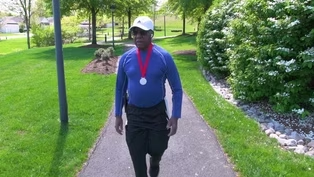
81-year-old trains for the Northern Virginia Senior Olympics
Video has Closed Captions
Clip: S2 Ep10 | 3m 39s | 81-year-old athlete Al Lamb says, “I want to win gold before I leave this world.” (3m 39s)

Addressing growing rates of Alzheimer’s disease
Video has Closed Captions
Clip: S2 Ep10 | 5m 4s | Alzheimer’s diagnoses are expected to increase in Virginia by 12% in 2025. (5m 4s)

Aging Well | People of Virginia
Video has Closed Captions
Clip: S2 Ep10 | 1m 13s | We asked the people of Virginia to share their thoughts on what it takes to age well. (1m 13s)

Baby boomers breaking the mold in retirement
Video has Closed Captions
Clip: S2 Ep10 | 1m 48s | The Baby Boomer generation faces retirement, but not all are ready to leave the workforce. (1m 48s)

Making connections after retirement
Video has Closed Captions
Clip: S2 Ep10 | 4m 2s | Keeping older adults active and connected as they age. (4m 2s)

Video has Closed Captions
Clip: S2 Ep10 | 3m 45s | The coronavirus still poses significant dangers, especially for older adults. (3m 45s)

Relying on science to open minds and create beauty
Video has Closed Captions
Clip: S2 Ep10 | 7m 43s | Art for the Journey has more than a million dollars available to serve more seniors (7m 43s)
Providing Support for PBS.org
Learn Moreabout PBS online sponsorship
- News and Public Affairs

Top journalists deliver compelling original analysis of the hour's headlines.

- News and Public Affairs

FRONTLINE is investigative journalism that questions, explains and changes our world.






Support for PBS provided by:
VPM News Focal Point is a local public television program presented by VPM